
Pamela D’Mello
First appeared in Sunday Midday, Mumbai in February 2011, based on an interview conducted in January 2011, several months before his passing in December 2011. Reposted here on 7 May 2026, on the occasion of the Mario Miranda centenary celebrations.
At a recent launch of five of his books, illustrator, artist and cartoonist Mario Miranda, though frail at 84, was very much the centre of attention. Hovering on the sidelines for a while, I finally went up and introduced myself. I’d done a couple of stories on Mario, interviewed him over the years on his restoration projects when he headed the Goa chapter of heritage foundation INTACH, but he was unlikely to remember. When I said “journalist”, Mario’s witty comeback was “Ah, so you’re the one who has been creating all that trouble”. I smiled. Despite its physical toll, time had done little to dim the humour and worldly astuteness of one of India’s most admired, and certainly most endearing cartoonist and illustrator.
On the telephone to seek an interview for this article, it was Mario who promptly answered, as he always did. So a day later I drove to meet Mario in his Loutolim lair, the grand 330-year-old ancestral mansion that had been in the family for generations. Because Mario’s drawings were so much a part of my childhood, one had always been slightly in awe of the tall, gracious artist who had so unforgettably chronicled Mumbai of the seventies and eighties, whose drawings in the venerable The Illustrated Weekly of India had made him an icon.
Obviously, age can sometimes be a deceptive box that would like to shut the brightest minds inside it, much before their time. “I don’t think about it (age). If you do, it becomes a trap” says Mario sagely, as he sits at his desk, his water colours and art material before him. “I get too many assignments. I’m sitting here trying to complete some”, he tells me.
“I love doing drawings, but I tend to get into a bad mood, if I am doing something and it does not come out the way I want it…that puts me off,” he says.
*****
Getting around and meeting people has always been inspiration for Mario’s work. And he isn’t about to give that up either, if he can help it.
So Mario and his wife Habiba, make it to as many social occasions as they can, driving miles from Loutolim in South Goa into the capital Panjim in the north, and even further oftentimes, determined not to let distance be a deterrent and surmount other physical limitations. “People say I’m a party-goer. But I love people. It’s a question of moving around and meeting people. I learn a lot from watching others,” he explains.
One is reminded of just how sharp a people-watcher Mario was, when going through his recent books, released in January 2011. Mario’s Bombay has hilarious, animated studies of people — tourists, gourmets, high-society types, common folk at railway stations, the Bombay dhabbawalla, the BEST bus conductor and so on. From 1953 until 1977, Mario drew, cartooned and illustrated for the Times Group publications — The Illustrated Weekly of India, Evening News, Filmfare, Femina, The Economic Times — producing a vast body of work. His funny and witty takes on the politics of that era, provide an incredible insight, though he has always been more a social cartoonist than a political one. His sketches done for the Pune Board Maharashtra school texts, like the Bal Bharati stamped his art deep into the psyche of an entire generation.
In Goa, one is surrounded by his art, every souvenir shop stocks curios with Mario’s drawings on them, much of it lifted without his permission. “It’s really a shame the way people copy him, without paying him any royalty” says fellow-villager and musician, Emiliano da Cruz. People tend to visit Mario and casually seek oral permissions to use this or that drawing, and before long, a whole line of products is out in the market. “He’s always been generous to a fault, he can never say no, and a lot of people have taken advantage of that”, da Cruz tells me.
Mario himself shrugs off the plagiarism, and has never made a big deal of it. “It can be flattering when the artist improves on my drawing, but it’s annoying when the humour is bad”, he jokes instead. It’s not unusual to visit a restaurant and sit beneath a blowup of Mario’s drawings, sometimes done without his permission.
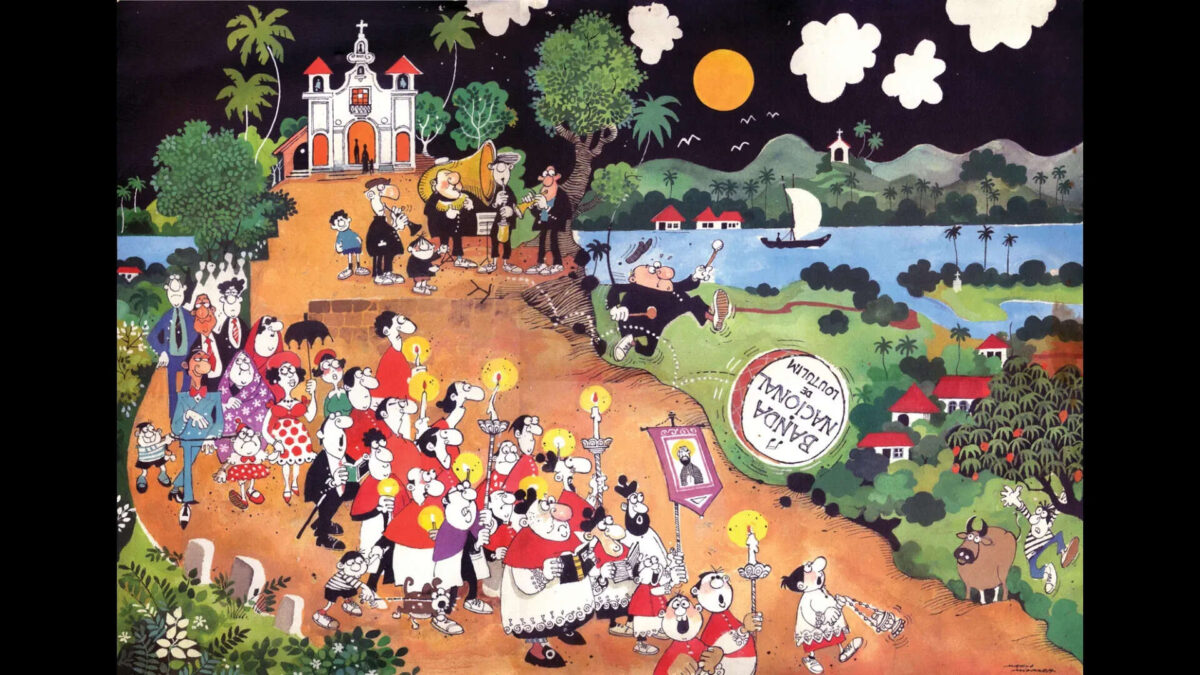
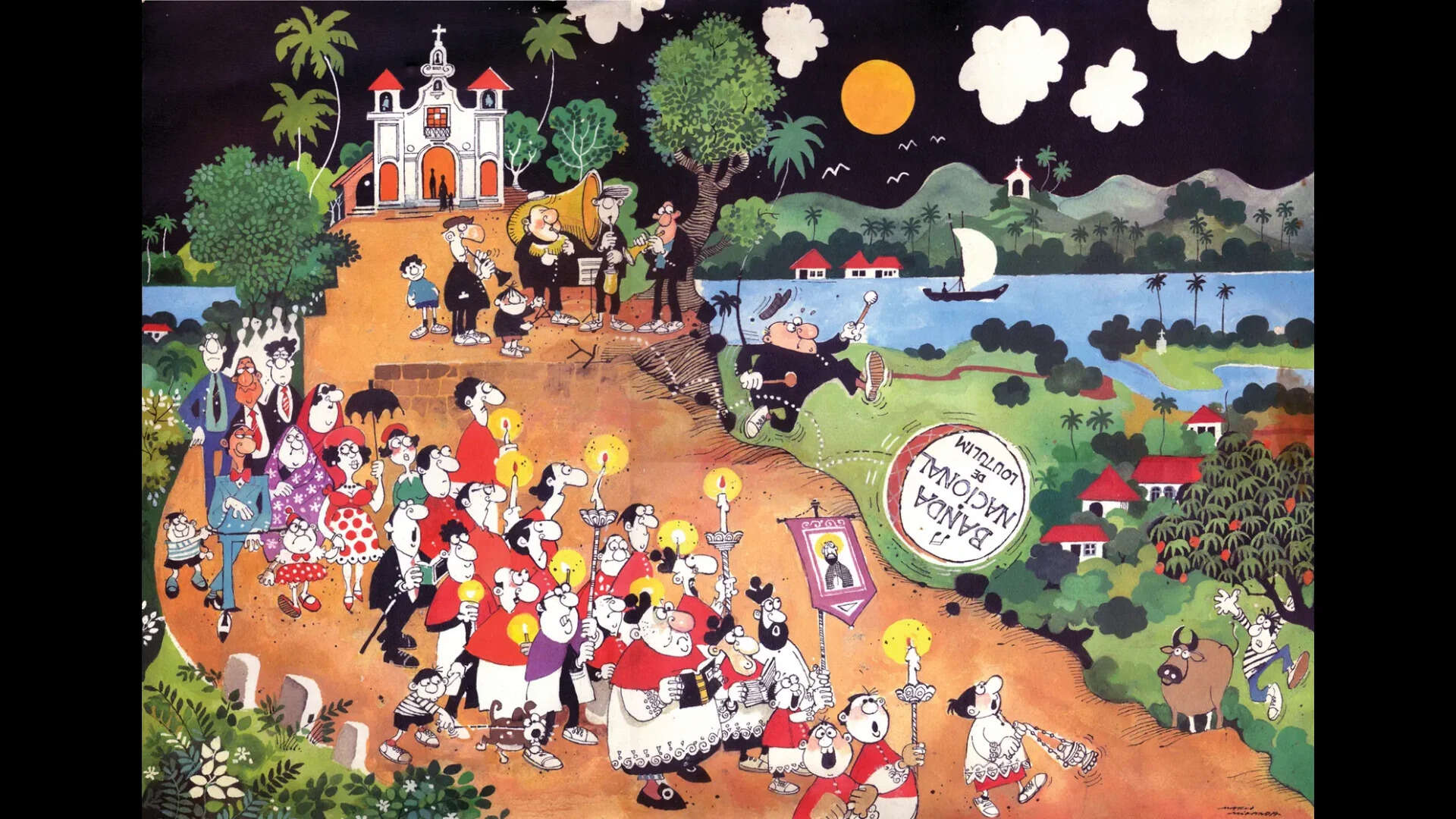
It struck me during the interview, that I was in the same house and village where Mario began his calling as an illustrator and cartoonist. The story goes that as a boy; an irrepressible young Mario was given a notebook by his wise mother to keep him from drawing on the house walls. Though Mario opted out of Bombay’s JJ School of Art after a single day, choosing instead to pursue a graduate course in the history of English literature at St. Xavier’s College, Mumbai —- he returned to Loutolim often to sketch numerous diaries that survive today as an invaluable pictorial chronicle of those colonial times. The diaries also landed him his first job doing cartoons for The Current and he’s always been grateful to its then editor D F Karaka. A year later he joined The Times of India group. Young and restless then, he left for a year’s stint in Portugal and spent a couple of years in London; before returning to The Times. “If I have any knowledge of humour and cartooning, it is due to my mixing with the English cartoonists mainly in London. I was lucky enough to meet Shultz, and Sir Ronald Searle, whose work I admire most.”
“Mario’s best cartooning work is really the work he did at The Illustrated Weekly of India when he returned back from London” opines Gerard da Cunha, publisher and editor of six books on Mario’s work, including a 285 page glossy magnum opus on the artist, published in 2008.
The second leap in Miranda’s career came when he toured the USA on a United States Information Service (USIS) invitation in 1972. Mario’s drawings and illustrations from that trip went into an exhibition that sold out. Since then, his stature as an illustrator grew, more so overseas; and he has been invited to sketch in over two dozen countries, including Spain in 2007, when he was 81. The catalogue and book of that last trip and exhibition is as good as any of his earlier work. A couple of years later however, Mario’s health took a turn.
“Everybody who sees my work, prefers my illustrations and drawings to my cartoons”, he pointedly tells me.
Architect-Publisher Gerard Da Cunha began a search for all of Mario’s work around 2006; delving into private collections and archives, aside from Mario’s own limited collection.
The result is a collection of 8000 prints, that are on view at a small museum in Goa. It’s a work-in-progress, a larger museum is in the offing. There are only small gaps in the archive of his work, says da Cunha; some of it done for the Mid-day and Afternoon Dispatch and Courier, calendars he illustrated for the National Safety Council and some of his work for Filmfare — to add to the 30 volumes of material already collected.
In it are all the memorable cartoon characters Mario created — the Bollywood heroine Rajani Nimbupani, the matinee star Balraj Balram, the archetypal politician Bundlebass, and the office secretary Miss Fonseca.
“If you look at his vast body of work, you realise just what a genius he is, he’s so versatile, his drawings are done in different styles. Sadly, he is recognised by the public only as a cartoonist, because of his huge popularity then, but his drawings mark him as a great artist”, says da Cunha.
The originals of much of Mario’s cartoons are lost, some by his own carelessness he admits. Some of it when the family shifted out of Mumbai in 1996. “Sometimes you take a lot of trouble over a drawing and that’s the end; you don’t see its lasting value. It goes to the press and is completely lost,” Mario tells me ruefully.
It wasn’t easy to move out of Mumbai, his wife Habiba tells me. For many years she missed the buzz of the city, her friends and the social circuit they were part of there. “We couldn’t go back; we only ever rented a place there” she says of their flat in Colaba’s Oyster Apartments. Habiba had been steadily restoring the Loutolim house, buying back family furniture heirlooms over the years. While they may have found living in Goa a tad quiet initially, Mario never ever wanted for commissions. He kept right on with his assignments, with The Economic Times, illustrating books and book covers. “Mario is unbelievably popular, a much-loved guy.
Even now people clamour to have him illustrate their books or draw something”, says da Cunha, who took the ‘Mario exhibition’ to several Indian cities, only to discover a steady flow of even middle-class viewers, not just the glitterati set who normally frequent art shows.
Connoisseurs have pointed out it is Mario’s humour and lack of malice in depicting situations and people, that endears him to his audience. Goa-based cartoonist and friend Alexyz calls him India’s ambassador of humour. At the apex of his career, Mario still found time to introduce Alexyz around Mumbai’s newspaper world, helping Alexyz get a break in Sportsweek, he recalls. “Above all he’s a great human being, and helps rank juniors if he can” says Alexyz.
Over the past decade, Mario has used his influence in many spheres, helping where he could. He was instrumental in launching the Museum of Christian Art in Goa. In Loutolim, he helped the local school and would have done more for the village if red tape had not stalled his plans, says his friend Emiliano da Cruz. His plans to see the Reis Magos Fort restored, for which he worked a great deal, may yet come through.
In the meanwhile, one senses Mario will not give up, when lesser mortals would. He reminisces to me about evenings in Mumbai’s coffee house culture, now long gone; the wonderful years he spent working with Pritish Nandy, Khushwant Singh, C R Mandy, Walter Langhammer, Behram and Farzana Contractor, and friend Dom Moraes. “I was lucky to have had the encouragement and support of great editors. I guess I happened to be at the right place at the right time”, Mario tells me.
He does not only lock himself in the past either, happy to engage with young artists. “There are a lot of bright young people. I like to meet them; many new acquaintances have become a part of my life”.
Giving up in not in Mario’s lexicon, it would seem. “I would like to paint; I never had the opportunity really to paint oil paintings or water colours even. So, when I have the chance of doing something like that, I jump at the idea,” he says. And he’s got plans for yet another book. So why stop?
See also: https://www.bbc.com/news/world-asia-india-36220327
https://frontline.thehindu.com/other/obituary/article30163954.ece